
Colorado’s Critical Asbestos Regulations: What Homeowners Need to Know
Planning a home renovation in Colorado? Before you swing that sledgehammer, there’s something you absolutely need to understand: Colorado’s asbestos regulations aren’t just strict—they’re in place to protect your family’s health and your financial wellbeing.
Hi there! I’m Craig Luckey from BuildSafe Environmental Consulting. Over the years, I’ve guided hundreds of homeowners through the maze of asbestos abatement Colorado requirements. What I’ve learned is that most people have no idea these regulations exist until they’re facing a stop-work order or, worse, a hefty fine.
Colorado takes asbestos seriously for good reason. These microscopic fibers, once disturbed during renovation or demolition, can lead to devastating health conditions like mesothelioma, lung cancer, and asbestosis. That’s why the Colorado Department of Public Health and Environment (CDPHE) has implemented some of the nation’s most comprehensive regulations.
Unlike many states, Colorado requires a certified asbestos inspection for all renovation and demolition projects—regardless of your home’s age. Yes, even that 1990s condo or your recently built home. This isn’t just bureaucratic red tape; it’s a crucial safety measure that protects everyone involved.
The regulations hinge on what we call “trigger levels”—the amounts of asbestos-containing materials that require formal abatement procedures. For residential properties, these trigger levels are 50 linear feet on pipes, 32 square feet on surfaces, or the volume of a 55-gallon drum. Commercial properties have higher thresholds: 260 linear feet, 160 square feet, or the same drum volume.
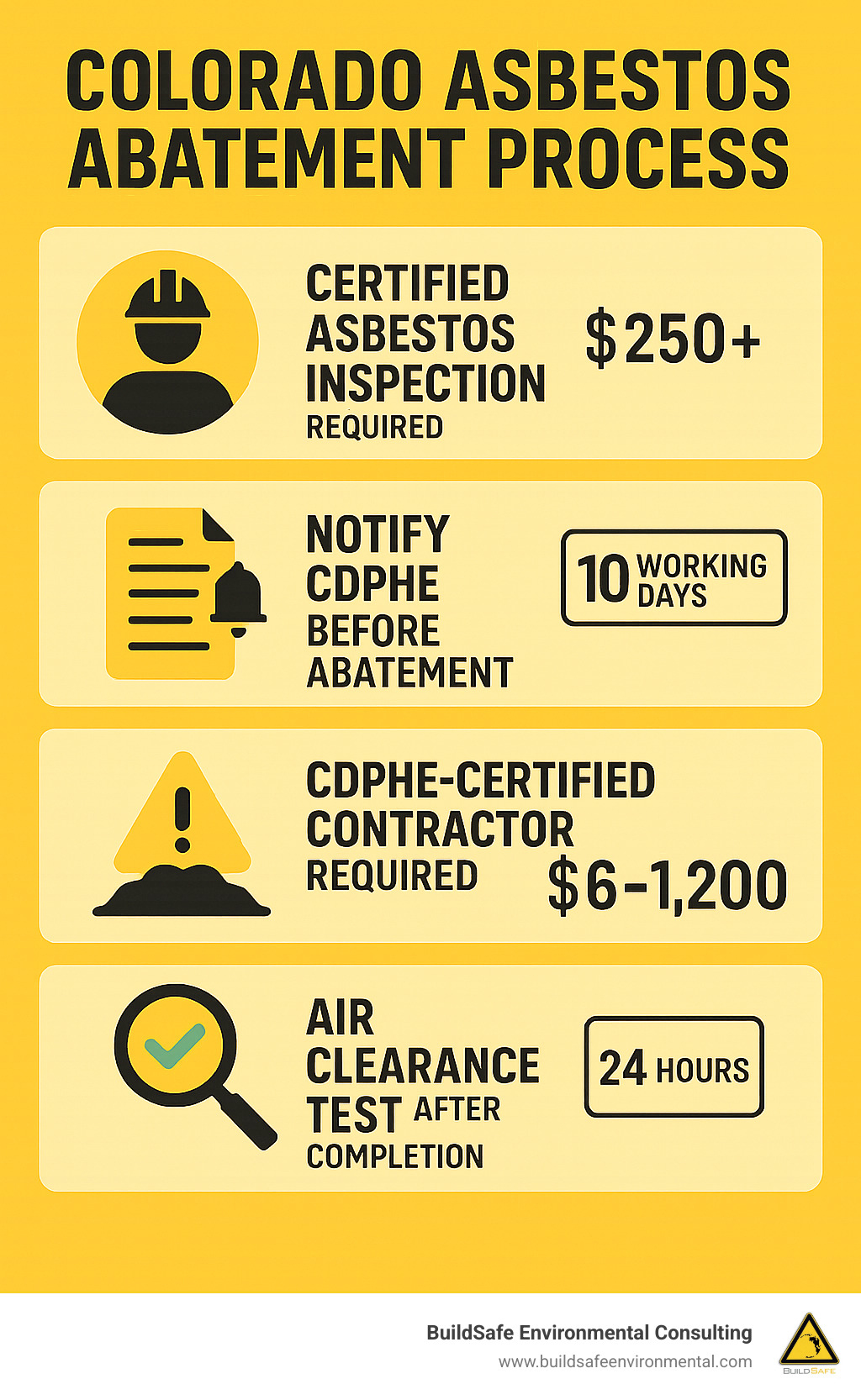
Once asbestos is identified above these trigger levels, you’ll need to file a notification with CDPHE at least 10 working days before beginning abatement (though emergency exceptions exist for situations like water damage). This notification comes with a fee ranging from $60 for smaller residential projects to $1,200 for larger commercial undertakings.
Perhaps most importantly, only CDPHE-certified contractors can legally perform asbestos abatement Colorado work. Attempting DIY removal is not just illegal—it’s dangerous and could lead to serious health consequences and legal liability.
The good news? With proper planning, these regulations don’t have to derail your renovation dreams. They simply add a layer of protection for your family and anyone who might work on your property. And while it may feel like an extra step, the peace of mind that comes from knowing your home is safe is truly priceless.
These regulations fall under Colorado’s Regulation 8 Part B and align with federal NESHAP (National Emission Standards for Hazardous Air Pollutants) requirements. Non-compliance can result in substantial fines, project delays, and potential liability issues down the road—especially if you later sell your home without proper disclosure.
At BuildSafe Environmental, we’ve seen how proper compliance from the start saves homeowners both stress and money in the long run. Because when it comes to asbestos abatement Colorado projects, doing it right the first time isn’t just smart—it’s essential.
Understanding Asbestos: Health Risks & Hidden Sources in Colorado
When you hear the word “asbestos,” you might picture old industrial buildings—but the truth hits much closer to home. This isn’t just one material, but a family of naturally occurring minerals that found their way into thousands of building products throughout Colorado homes and businesses.
These tiny fibers earned their popularity honestly—they resist heat, electricity, and chemicals while providing strength and sound absorption. Unfortunately, these same impressive qualities make asbestos extraordinarily dangerous when disturbed.
When asbestos-containing materials break down, they release microscopic fibers that can float in the air for days—especially in Colorado’s dry, high-altitude environment where particles remain airborne longer than in humid climates. Once inhaled, these invisible invaders can trigger devastating health conditions:
Lung Cancer can develop 15–35 years after exposure, mimicking smoking-related cancer but affecting even non-smokers exposed to asbestos.
Mesothelioma, an aggressive cancer attacking the lining of lungs, heart, or abdomen, typically appears 20–50 years after exposure—often when it’s already advanced.
Asbestosis creates permanent lung scarring that progressively reduces breathing capacity, typically emerging 10–20 years following heavy exposure.
The Centers for Disease Control confirms what makes asbestos particularly frightening—there is no known safe exposure level. Every fiber increases your risk, and the decades-long latency period means today’s exposure might not show symptoms until retirement age.
Where Asbestos Hides in Centennial-State Buildings
“Is my home safe?” It’s the question I hear most often during inspections. The answer depends largely on when your property was built, but age alone isn’t a guarantee either way.
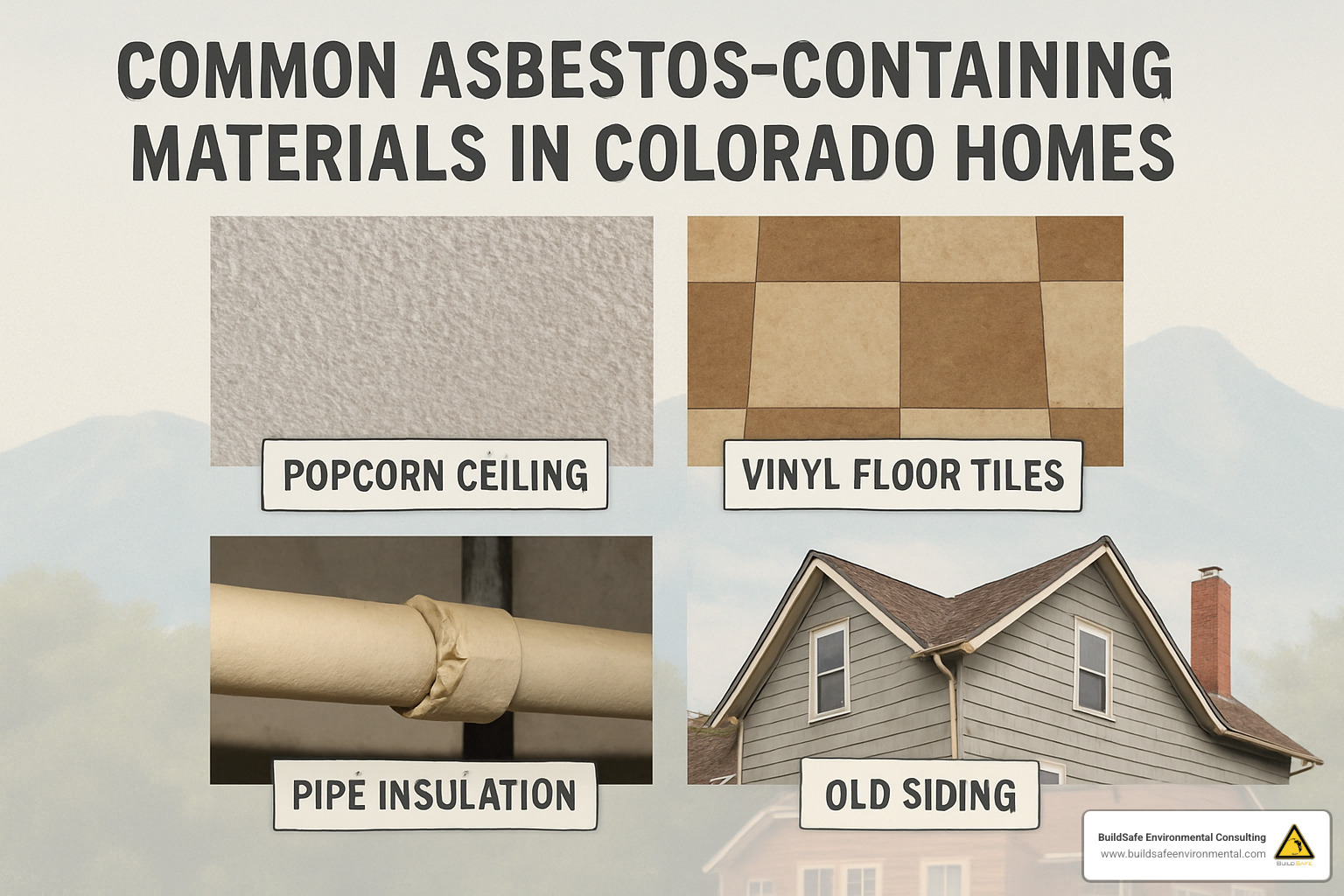
In Colorado homes built before 1980, asbestos is remarkably common. Those charming textured “popcorn” ceilings found throughout Denver’s older neighborhoods? They frequently contain asbestos. The vintage vinyl flooring in your Boulder bungalow? Likely asbestos-laden. That insulation keeping your Colorado Springs home warm through mountain winters? Potentially dangerous if disturbed.
Even homes built after the 1988 partial ban aren’t automatically safe. Imported materials continued to contain asbestos well after domestic regulations tightened.
In residential properties across the Front Range, be particularly watchful for asbestos in popcorn ceilings, vinyl floor tiles, pipe insulation, vermiculite attic insulation (often from the infamous Libby, Montana mine), Transite siding, furnace duct wrap, and roofing materials designed to withstand Colorado’s intense sun.
Commercial buildings throughout the state present their own challenges, with asbestos often hiding in sprayed-on fireproofing (common in Denver high-rises), acoustic ceiling tiles, extensive pipe insulation, HVAC components, fire doors, elevator parts, and various sealing compounds.
The good news? Intact, undisturbed asbestos generally poses minimal immediate risk. The danger emerges when renovation, damage, or deterioration occurs.
Why Disturbance Equals Danger
The term that matters most in asbestos abatement Colorado regulations is “friable”—materials that can be crumbled by hand pressure, releasing fibers into the air. Many asbestos materials start as non-friable but become dangerous during renovation.
A Denver homeowner recently shared: “I had no idea the old vinyl flooring contained asbestos until I’d already torn up half the bathroom floor. By the time I called for testing, I’d potentially exposed my entire family. The abatement ended up costing three times what it would have if I’d tested first.”
This story repeats itself throughout Colorado—during ceiling removals in Fort Collins, siding replacements in Grand Junction, and basement remodels in Colorado Springs. Common activities that release asbestos include cutting drywall compound, scraping textured ceilings, removing floor tiles, tearing out insulation, and drilling through cement board siding.
Once released, these invisible fibers create exposure through inhalation (the primary danger), secondary contamination (fibers settling on clothing and hair), and resuspension (settled fibers becoming airborne again during cleaning).
What makes asbestos abatement Colorado requirements particularly strict is the understanding that exposure is cumulative—each instance adds to your lifetime risk. There’s no “one-time exposure” pass. These microscopic fibers are invisible, odorless, and tasteless—you could be breathing them without any immediate awareness.
The altitude and climate factors unique to Colorado can actually worsen exposure risk. Our thin mountain air and low humidity allow asbestos fibers to remain suspended longer and travel farther than in coastal environments, potentially increasing exposure duration and spread throughout a property.
Understanding these risks isn’t meant to cause panic, but rather to emphasize why proper testing before any renovation is not just a regulatory requirement in Colorado—it’s a critical health protection for you and your family.
Regulations & Trigger Levels for Asbestos Abatement Colorado
If you’re navigating Colorado’s asbestos regulations, you’re dealing with some of the most comprehensive rules in the nation. The Air Quality Control Commission’s Regulation 8, Part B serves as the backbone of these requirements, implementing both state standards and federal guidelines under the National Emission Standards for Hazardous Air Pollutants (NESHAP).
What makes our state special? Since 1995, Colorado has held a federal waiver to fully administer the Asbestos Hazard Emergency Response Act (AHERA) regulations. This means everything asbestos-related—from the initial inspection to the final disposal—falls squarely under the Colorado Department of Public Health and Environment (CDPHE).
At the heart of asbestos abatement Colorado regulations are “trigger levels”—specific thresholds that determine when you need to bring in the professionals.
For your single-family home, the residential trigger levels are 50 linear feet on pipes, 32 square feet on other surfaces, or the volume of a 55-gallon drum. Exceed any of these, and you’re required to follow formal abatement procedures.
Commercial properties (including apartment buildings) face higher thresholds: 260 linear feet on pipes, 160 square feet on surfaces, or the same 55-gallon drum volume. These differences reflect the varying scales of residential versus commercial projects, but the safety intent remains the same.
These trigger levels apply to your entire project. That small bathroom demo plus the kitchen renovation could easily add up to exceed these thresholds when calculated together.
When you cross these trigger levels, the requirements kick in: you’ll need a Colorado-certified General Abatement Contractor, a formal CDPHE notification with appropriate fees, and you’ll face a mandatory 10-day waiting period before work can begin. Plus, you’ll need to follow specific removal procedures and dispose of materials at an approved waste site.
For more details on specific regulations, the Asbestos in Colorado: Rules, Regulations, and Testing guide provides a comprehensive overview.
When Is an Asbestos Inspection Required in Colorado?
“My house was built in 2000, so I don’t need to worry about asbestos, right?”
I hear this misconception almost daily, and I have to deliver the surprising news: In Colorado, the age of your building doesn’t matter when it comes to asbestos inspections.
State law requires an asbestos inspection by a certified professional for all renovation and demolition projects, regardless of when your building was constructed. This applies to any project requiring a permit, any remodel that might disturb building materials, and all demolition work—whether you’re taking down an entire structure or just a single wall.
The only potential exemption exists for buildings constructed after October 12, 1988, but only if the original architect or engineer provides written certification that no asbestos-containing materials were used. In my 15 years of experience, I’ve seen this exemption successfully used exactly twice—most architects won’t take on that liability, especially knowing that some imported materials contained asbestos even after the partial ban.
A Denver contractor once told me, “I figured a 1990s building would be safe, so we started demo without testing. Next thing I know, a CDPHE inspector is shutting down my entire project and we’re facing $25,000 in fines. Now we test everything—no exceptions.”
Legal Consequences of Non-Compliance
The penalties for ignoring asbestos abatement Colorado regulations can hit you from all sides—and they’re designed to make compliance the much easier path.
On the regulatory front, CDPHE can issue fines up to $25,000 per day for each violation, while the EPA can pile on additional federal penalties up to $37,500 daily. For those who knowingly violate the regulations, criminal charges may enter the picture.
Your project will also suffer immediate consequences: work stoppage orders, frustrating delays while you arrange proper abatement, and significantly higher costs for emergency removal. Many contractors find their future building permits denied because of past violations.
The liability exposure extends far beyond regulatory fines. You could face personal injury lawsuits from workers or building occupants, property damage claims, workers’ compensation issues, and insurance headaches. Your insurer might even raise your premiums or deny coverage altogether.
Even after the project ends, the troubles can continue. Colorado law requires you to disclose known asbestos to future buyers, which can complicate property sales, mortgage applications, and financing.
As a CDPHE enforcement officer once candidly told me, “We’re not out to punish honest mistakes, but we take willful violations very seriously. These rules protect public health, and we’ve seen too many cases where cutting corners led to dangerous exposures.”
The bottom line? Testing before your project begins is always cheaper, safer, and less stressful than dealing with the alternative. When it comes to asbestos abatement Colorado requirements, an ounce of prevention truly is worth a pound of cure.
Step-By-Step Asbestos Abatement Colorado Process
Navigating the asbestos abatement Colorado process doesn’t have to feel overwhelming. After helping hundreds of Colorado homeowners and businesses through this journey, I’ve seen how a systematic approach makes all the difference in keeping your project safe, compliant, and on budget.
Let me walk you through what happens during a typical abatement project:
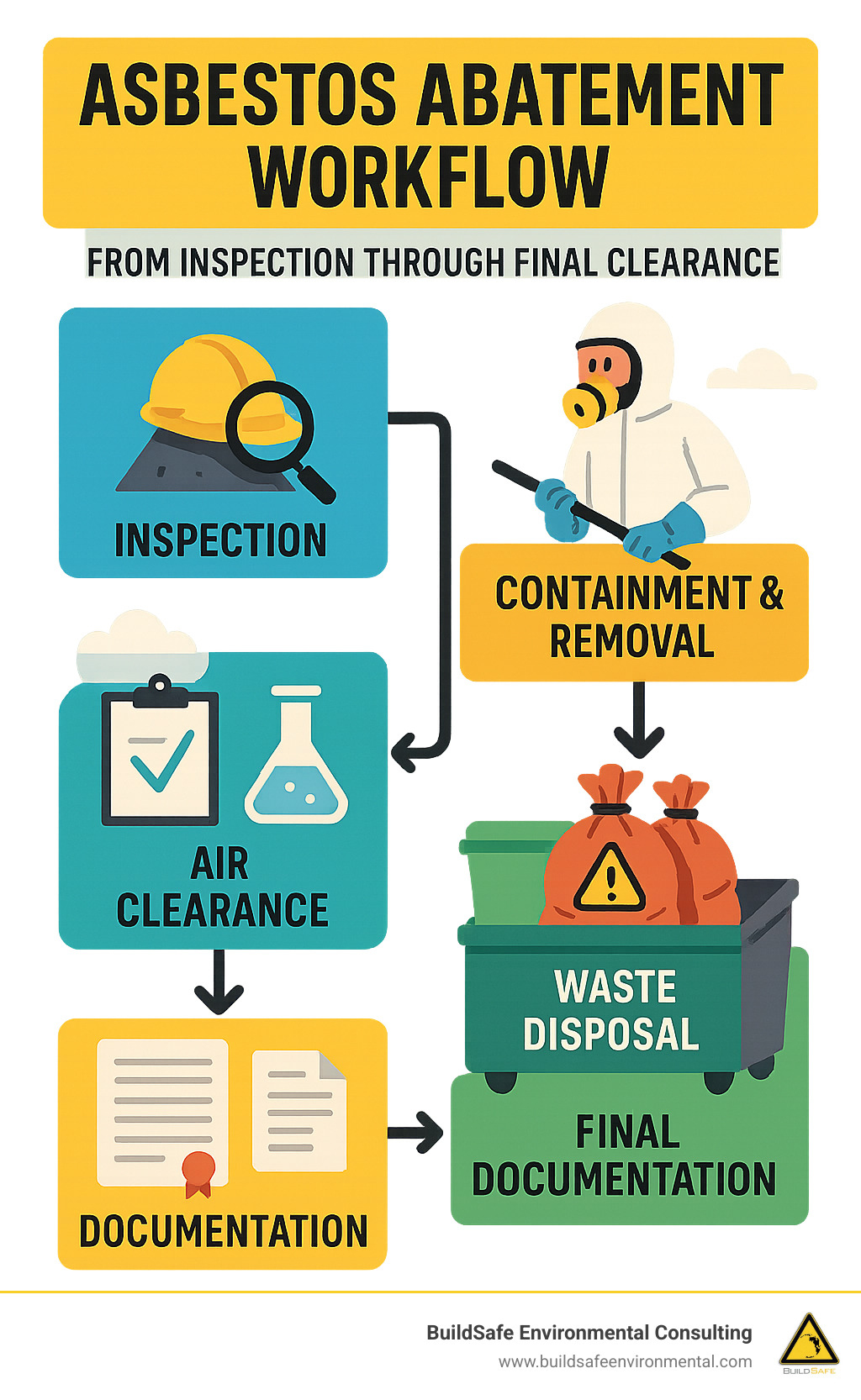
1. Initial Inspection and Testing
Every successful abatement starts with a thorough inspection. A certified inspector (like our team at BuildSafe) will carefully examine all areas that might be disturbed during your renovation or demolition. We’re looking for any suspicious materials that might contain asbestos.
During this visit, we’ll collect multiple samples—usually 3–7 from each type of material—and document exactly where they came from. This careful documentation creates what we call a “chain of custody” that tracks your samples from collection to final results.
2. Laboratory Analysis
Those samples then head to an accredited laboratory where trained analysts put them under special microscopes. They’re looking not just for the presence of asbestos, but also the percentage and specific type (like chrysotile or amosite).
Most results come back within 1–3 days, though we can arrange rush analysis if your project timeline is tight. I always tell clients this waiting period is actually saving them time and money in the long run—knowing exactly what you’re dealing with prevents costly surprises later.
3. Abatement Planning
If asbestos is found above Colorado’s trigger levels, we’ll need a detailed plan before moving forward. This plan isn’t just paperwork—it’s your roadmap to safety.
A good abatement plan includes the exact scope of work, how containment will be set up, what air monitoring will take place, how workers will be protected, and how waste will be handled. For complex projects, you might need a certified Project Designer to create this plan, though many residential projects can use standard protocols.
4. Notification and Permitting
Before any abatement work begins, Colorado law requires formal notification to the state. This means submitting forms to CDPHE and paying the appropriate fees, which range from $60 for a typical residential project to $1,200 for larger commercial jobs.
Then comes the waiting game—a mandatory 10-working-day period before work can begin. This isn’t just bureaucratic red tape; it gives regulators time to review your project and potentially inspect if needed. In true emergencies, this waiting period can sometimes be shortened, but you’ll need to document why the situation qualifies as an emergency.
5. Containment Setup
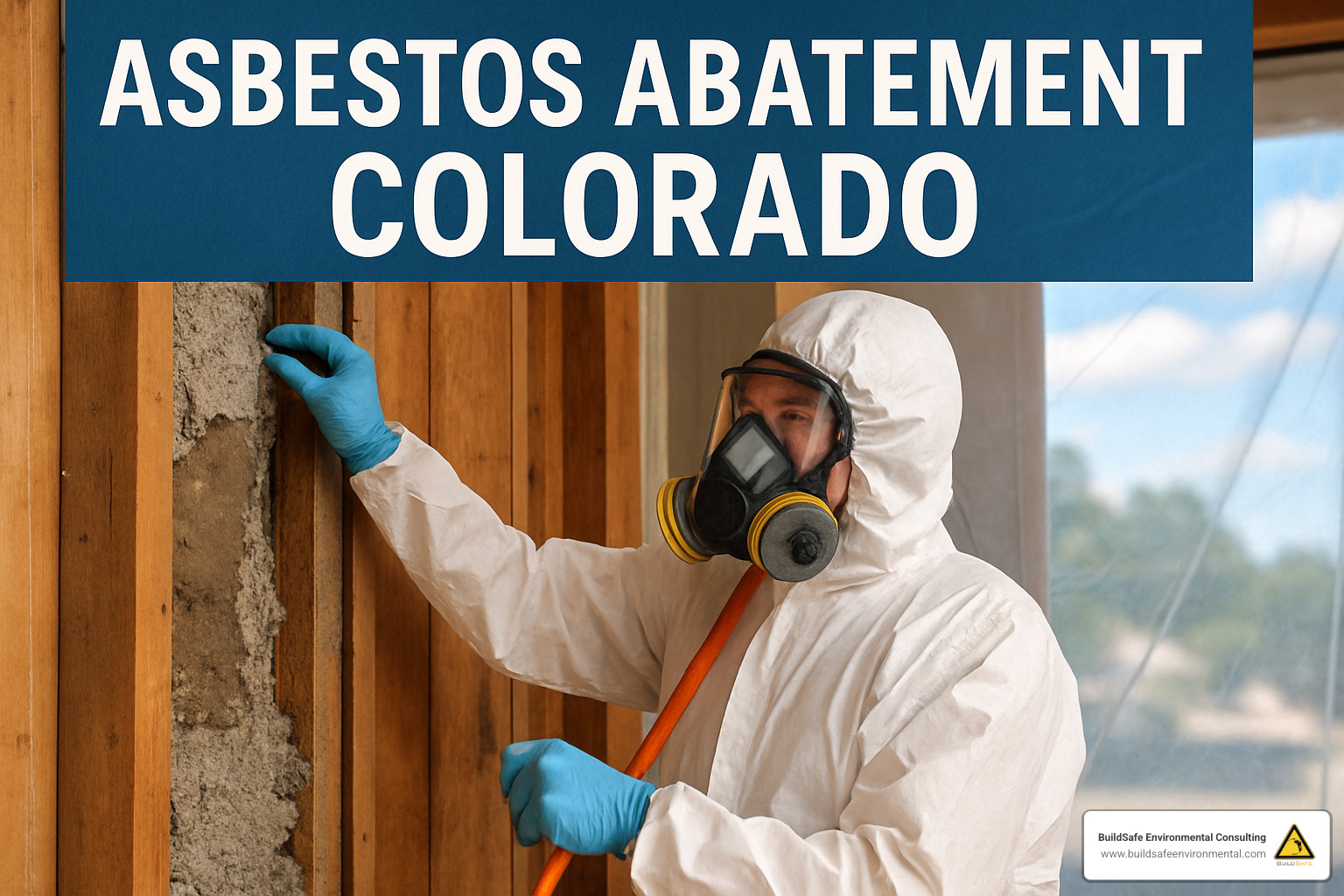
Now things start getting serious. The abatement contractor will transform the work area into what looks a bit like a scene from a sci-fi movie. They’ll seal off the area with heavy plastic sheeting over all openings—windows, doors, vents—anything where air might escape.
Perhaps most important is the negative air pressure system. Special HEPA-filtered machines continuously pull air from the containment area, creating slightly lower air pressure inside than outside. This means that if there’s any leak in the containment, air flows inward rather than allowing contaminated air to escape.
Workers will also set up decontamination areas—special chambers where they can safely enter and exit without tracking asbestos fibers outside the containment. Warning signs go up, and access becomes strictly limited.
6. Removal or Encapsulation
With everything in place, the actual abatement begins. Certified workers wearing appropriate protective gear will either remove the asbestos-containing materials or, in some cases, encapsulate them (seal them in place with special coatings).
During removal, materials are typically wetted down to keep fibers from becoming airborne—a simple but effective technique. As materials are removed, they go immediately into leak-tight containers. Workers carefully clean surfaces using specialized HEPA vacuums and wet-wiping techniques to capture any loose fibers.
7. Visual Inspection and Air Clearance
Once the contractor believes they’ve completed the abatement, it’s time for verification—and this is where having an independent third party like BuildSafe becomes invaluable.
First comes a detailed visual inspection to confirm all identified materials have been properly removed or encapsulated. Then comes air testing to prove the area is safe. For schools and public buildings, samples must undergo Transmission Electron Microscopy (TEM) analysis, which can detect even the tiniest asbestos structures. Residential projects may use the slightly less sensitive Phase Contrast Microscopy (PCM) method.
These air samples are your guarantee that the space is truly safe to reoccupy—and why cutting corners on this step is never worth the risk.
8. Waste Transport and Disposal
Asbestos waste requires special handling from start to finish. All materials must be double-bagged or wrapped in leak-tight containers with proper warning labels. Only authorized carriers can transport this waste, and it can only go to specific landfills approved for asbestos disposal.
Every step generates paperwork—waste shipment records that track the material from your property to its final disposal. These records become part of your project documentation and may be required if you sell your property in the future.
9. Final Documentation
The project isn’t truly complete until you have comprehensive documentation in hand. This includes your original inspection report, laboratory results, all notifications and permits, daily work logs, air monitoring results, waste disposal manifests, and final clearance documentation.
I always tell clients to keep these records forever—they’re invaluable proof that you handled asbestos properly, which protects you from future liability and makes any property transaction much smoother.
Asbestos Abatement Colorado After Fire or Water Damage
Disaster situations create special challenges for asbestos abatement Colorado projects. The devastating Marshall Fire that swept through Boulder County in December 2021 taught us many lessons about handling asbestos in crisis situations.
Fire damage makes asbestos-containing materials more dangerous because the heat can make previously stable materials friable—meaning they easily release fibers. The ash and debris may be heavily contaminated, requiring specialized handling procedures. The good news is that emergency permit procedures often exist to help expedite the process, though coordination with insurance adjusters becomes an additional layer of complexity.
The CDPHE has developed specific guidance for handling wildfire debris, which you can access through the Boulder Office of Emergency Management.
Water damage presents different challenges. Moisture can break down the binders in asbestos-containing materials, making them more likely to release fibers. When dealing with water damage, you’re often facing a double threat of both mold and asbestos, requiring careful coordination between remediation efforts. Drying equipment must be used cautiously to avoid creating air currents that could disturb asbestos fibers.
I remember working with one family whose basement flooded, damaging old floor tiles that contained asbestos. “We had no idea we were dealing with two problems at once,” they told me. “Having someone coordinate both the mold and asbestos testing saved us from potentially making the situation much worse.”
Clearance Testing & Re-occupancy
The final step in any asbestos abatement Colorado project is verifying that the space is truly safe to reoccupy. This verification is where BuildSafe Environmental Consulting’s role as an independent third party becomes crucial.
First, we conduct a thorough visual inspection, looking for any remaining asbestos-containing materials and checking that all surfaces are clean and free of visible dust or debris. But looking clean isn’t enough—we need to confirm the air is safe too.
For air testing, we use what’s called “aggressive sampling.” This means we deliberately stir up any potential dust using fans and leaf blowers before collecting air samples. It might seem counterintuitive, but this worst-case scenario testing gives you confidence that even if someone were to create similar air disturbance later, the levels would still be safe.
The samples are analyzed in a laboratory using either Phase Contrast Microscopy (PCM) for residential projects or the more sensitive Transmission Electron Microscopy (TEM) for schools and public buildings. To pass clearance, air must contain less than 0.01 fibers per cubic centimeter for PCM or 70 structures per square millimeter for TEM.
Once the results confirm the area is safe, we issue a formal clearance report. This document is your evidence that the project was completed properly and the space is safe for reoccupancy.
This independent verification process provides several crucial benefits:
- It objectively confirms the abatement contractor did their job effectively
- It provides documentation that you’ve complied with all regulations
- It gives you evidence for insurance claims
- Most importantly, it provides peace of mind that your home or building is truly safe
For more detailed information about the testing process, visit our Asbestos Testing page.
Permits, Certified Contractors, and Safe Disposal
Navigating the maze of permits for asbestos abatement Colorado projects can feel overwhelming, but understanding the process is crucial for your project’s success and legal compliance. Since September 2020, Colorado has streamlined things somewhat—all asbestos-related payments must now go through the CDPHE online payment portal, with payment receipts attached to your notifications and applications.
The cost structure varies depending on what you’re doing. For homeowners, a Single Family Residential Dwelling Notice runs about $60—relatively affordable compared to commercial projects, which can range from $800 for a 90-day permit to $1,200 for a full-year permit. These fees help fund the oversight that keeps Coloradans safe from asbestos exposure.
When it comes to who can legally perform the work, Colorado law is crystal clear—this isn’t a DIY situation. Only properly certified professionals can handle asbestos legally and safely.
A General Abatement Contractor must hold current CDPHE certification, which costs them $2,000 initially. The individual workers need their own certifications ($125 per person), while supervisors require a specific certification ($250). If your project requires special design considerations, that person needs separate certification ($250) as well.
Perhaps most importantly, the air monitoring specialist who verifies the space is safe afterward must be independent from the abatement contractor—this separation provides crucial checks and balances to ensure your safety isn’t compromised.
“I’ve seen too many people try to save money by hiring uncertified contractors,” shares Craig Luckey from BuildSafe Environmental. “It always ends badly—usually with stop-work orders, fines, and having to pay twice to get it done properly.”
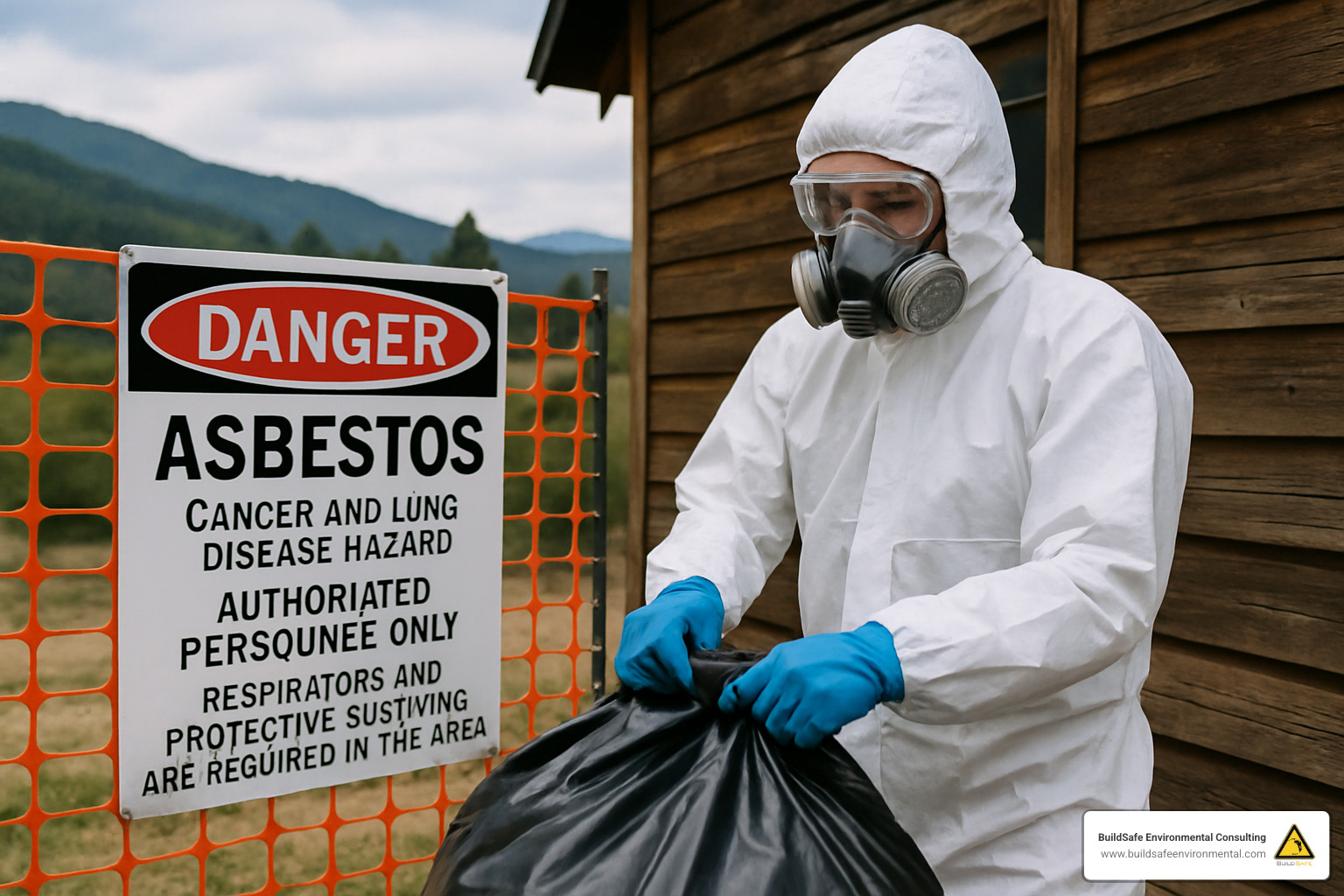
What happens to the asbestos once it’s removed is equally regulated. It’s not as simple as tossing it in a dumpster. The material must be thoroughly wetted to prevent fiber release, then sealed in special leak-tight containers with specific asbestos warning labels. Transportation follows strict Department of Transportation regulations, and disposal is permitted only at specially designated landfills approved for asbestos waste.
Throughout this entire process, a complete chain-of-custody must be maintained through waste manifests—essentially creating a paper trail showing exactly where every bit of asbestos went from your property to its final resting place. This documentation protects you from future liability and ensures proper handling at every step.
For a more detailed breakdown of the removal process, our guide on What You Need to Know About Asbestos Removal covers everything step-by-step.
Choosing the Right Professional
Selecting qualified professionals for your asbestos abatement Colorado project might be the most important decision in the entire process. The right team ensures safety, compliance, and peace of mind—while the wrong choice can lead to health risks, legal troubles, and financial headaches.
For asbestos inspectors, verify their current CDPHE certification through the state website before proceeding. They should have completed AHERA Building Inspector training and carry professional liability insurance. Experience with projects similar to yours is invaluable, as is clear communication and detailed reporting. At BuildSafe, we pride ourselves on explaining complex results in plain English, so you fully understand what you’re dealing with.
When selecting an abatement contractor, verification is equally important. Ensure they hold current CDPHE General Abatement Contractor certification, along with workers’ compensation and liability insurance. They should be properly bonded for project completion and have specific experience with your type of project. Don’t hesitate to ask for references from similar jobs—reputable contractors will gladly provide them.
Watch for warning signs that might indicate problems ahead. Significantly lower bids than competitors often signal corners will be cut. Be wary of contractors reluctant to provide license numbers or insurance certificates, those who pressure you to skip testing or permits, or anyone unwilling to use independent air monitoring. Vague proposals or contracts are another red flag—everything should be crystal clear before work begins.
“We initially went with the lowest bidder,” shares Denver homeowner Jennifer Martinez, “but they seemed hesitant about pulling permits. We switched to a properly certified contractor who charged more but handled everything by the book. The peace of mind was worth every penny.”
Homeowner Action Plan if Asbestos Is Found
If you’re a Colorado homeowner and find or suspect asbestos in your property, take a deep breath—then follow this straightforward plan:
First, stop any work immediately that might disturb the material. Even minor disturbance can release dangerous fibers.
Next, hire a certified inspector to test suspicious materials. At BuildSafe Environmental Consulting, we provide fast, reliable testing with clear explanations of results, typically with a 24–48-hour turnaround.
Once you have results, evaluate the findings to determine if trigger levels will be exceeded. If below trigger levels, work may proceed with proper precautions. If above trigger levels, formal abatement with all the proper notifications becomes necessary.
When abatement is needed, file the proper notification with CDPHE and pay applicable fees. Then select a certified abatement contractor using the criteria we’ve outlined above. For larger projects, you might need to plan for temporary relocation during the abatement process.
After abatement, ensure independent clearance testing is performed before anyone reoccupies the space. This third-party verification is your assurance that the job was done right.
Throughout the process, retain all documentation including the initial inspection report, laboratory results, abatement notification and permit, contractor invoices and scope of work, waste disposal manifests, and the clearance testing report. This paperwork will be important if you ever sell your property.
Proper handling of asbestos isn’t just about checking regulatory boxes—it’s about protecting your health, your family’s health, and the health of anyone who works on or visits your property. The process may seem daunting, but with the right partners, it becomes manageable. At BuildSafe Environmental, we guide Colorado homeowners through this journey every day, providing the expertise and support needed to handle asbestos safely and legally.
Conclusion & Next Steps
Navigating the complex world of asbestos abatement Colorado regulations might seem overwhelming at first glance. But now that you understand the process, you’re already on your way to ensuring a safe, compliant renovation or demolition project. At BuildSafe Environmental Consulting, we’ve walked alongside hundreds of homeowners and contractors through this challenging terrain, providing the independent verification that’s essential for true peace of mind.
Let’s take a moment to review what we’ve covered:
Colorado requires asbestos inspection for all renovation and demolition projects—no exceptions based on building age. This isn’t just bureaucratic red tape; it’s a vital protection for you, your family, and anyone who works on your property.
The trigger levels determine when formal abatement becomes necessary. For residential properties, that’s 50 linear feet on pipes, 32 square feet on surfaces, or the volume of a 55-gallon drum. Commercial properties have higher thresholds: 260 linear feet, 160 square feet, or the same drum volume.
Working with properly certified professionals isn’t just recommended—it’s required by law. Your inspector, abatement contractor, and clearance testing professional should all have current CDPHE certifications specific to their roles.
Remember the mandatory 10-working-day waiting period after filing your notification and permit. It’s tempting to rush, especially when your renovation timeline is tight, but this step ensures proper oversight and compliance.
Proper disposal matters too. Asbestos waste must go to approved facilities with complete documentation. Those waste manifests might seem like just another piece of paper now, but they provide crucial protection if questions arise later.
Documentation is your friend throughout this process. From initial inspection reports to laboratory results, permit applications to clearance testing—keep everything. These records protect you during regulatory inspections and provide essential disclosure information for future property transactions.
The stakes are high when it comes to asbestos compliance. Fines can quickly reach tens of thousands of dollars. Projects can grind to a halt with stop-work orders. And most importantly, improper handling creates serious, long-term health risks for everyone exposed. But with thoughtful planning and professional guidance, you can manage asbestos abatement safely and efficiently.
If you’re planning a renovation, I strongly recommend reading our detailed article on Asbestos Testing – Why It’s Crucial Before a Renovation Project. It dives deeper into the reasons testing should be your first step, not an afterthought.
Are you ready to ensure your project complies with all asbestos abatement Colorado regulations? At BuildSafe Environmental Consulting, we provide fast, reliable asbestos testing services throughout Denver, Longmont, Fort Collins, and across the state. As your third-party verification partner, we remain independent from abatement contractors—giving you truly unbiased results you can trust.
Take that first step toward a safe, compliant project today by scheduling certified asbestos testing. Because when it comes to asbestos, what you don’t know really can hurt you—and your investment is worth protecting the right way.